
About The Founder
Pandit Kaviraj Dr. Ananta Tripathy Sharma (1905 – 1991)
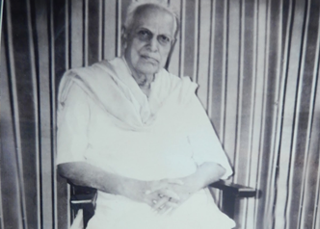
Pandit Kaviraj Dr. Ananta Tripathy Sharma was born on 10th February 1905 in Jagannathapur Sasana, P.O. Gunthapada, Ganjam district, Odisha. His father Shri Gadadhara Tripathy was a famous Vaidya as well as an astrologer of that era, and his mother Shrimati Mohini Devi was a housewife. He was the youngest among three brothers. His elder brother Sri Chandra Sekhara Tripathy was a learned Sanskrit Pandit, educated at Kashi.
His early education was at his elder brother's chatasali; later his uncle took him to Baripada to study Vyakarana Madhyama. After completing it, he joined Vijayanagar Sanskrit College and obtained the “Sahitya Shiromani” degree in 1925. On the invitation of the Parala King, he joined as a lecturer in English College, Paralakhemundi on 14th June 1926. There he was attracted to English studies and by his own effort obtained I.A. and B.A. degrees. The King of Parala was highly influenced by his personality and depth of knowledge, and appointed him as Lecturer of Sahitya in the Sanskrit College. His presence made it a famous institute of Sanskrit.
Social Reform
In those days child marriage was a social taboo. It hurt him deeply and he started a movement against it. Along with Shree Shashibhusan Ratha, editor of Dainik Asha, he started a sustained movement in writing and spread the message among the people of southern Odisha. Later he was drawn towards Ayurveda and completed the Ayurvedacharya degree. After completing the degree he started a clinic, which spread to Vijayanagaram, Parvatipuram, Srikakulam and Brahmapur as separate units.
Public Life
In 1946, before independence, it was planned to institute a district board and a good candidate was sought for the Aska constituency. Due to his popularity, Ananta Tripathy Sharma was unanimously chosen. There was a tough contest but at last he won the election. After his election many centres of Ayurvedic treatment started replacing allopathic centres as a part of the Swadeshi movement. To supply proper medicines to those centres, a central pharmacy was also constituted.
Because of his generous activities, Congress decided to make him the MLA candidate for the Paralakhemundi constituency. He won this election too, due to his huge popularity. After being elected to the assembly he got a broad field to popularise Ayurveda in the state as well as in India. He presented many proposals for the betterment of Ayurveda to the government and was elected as the state candidate for the All India Ayurveda Mahasammilani. He played an important role in starting a uniform BAMS course all over India. With this aim a team was constituted in Odisha; as a result Gopabandhu Ayurveda Mahavidyalaya was established at Puri to start the BAMS course in Odisha.
He was later elected as Member of Parliament from 1962 to 1971, i.e. continuously three times. Due to his personality he very soon won the hearts of eminent parliamentarians as well as Prime Minister Pandit Nehru.
Legacy
He had a special dedication to the development of Ayurveda. Due to his active participation, in 1957 he was elected as the President of Nikhila Bharata Ayurveda Congress — the only Odia to hold this post. After the division of Congress he gradually kept away from politics and dedicated more time to the development of Ayurveda and literature. To further these causes he established Siromani Press.
It was then time to start an Ayurveda College in Brahmapur. He tried hard, consulted many eminent persons, collected money from different sources as donations, and started the college on 15th August 1978 at Chaturbhuja Dharmasala, Berhampur, later shifted to Ankushpur. In 1990 he celebrated twelve years of the institute and left the world on 11th July 1991. The college he created is now named after him and will remain immortal, carrying his message to the next generation forever.